You Cannot Accidentally Get Strong
Strength was always the point.
There is a story people tell about C2 right now, and I want to correct it.
The story is that we were a CrossFit gym, and now we are adding a bunch of new classes.
Strength class, conditioning class, all of it new.
That is not what happened.
We have been a strength and conditioning facility since the day we opened in 2013. CrossFit was the vehicle. It was a good one. It gave us a community, a language, and a framework that got a lot of people fit who otherwise would have spent thirteen years not training at all. I do not take that lightly and I will not pretend otherwise.
If you have been around me for more than about a week, you already know where my head has always been. Ask anyone who trained here in 2015. Ask any coach who has sat through my programming conversations.
The barbell was never a garnish. It was always the main course.
Why I care this much
I am not a purist about the barbell for its own sake. I care about what strength buys you, and the list is longer than most people realize.
Muscle is the tissue your body draws down as you age, and past about forty you lose it whether or not you have agreed to. Bone responds to load and to almost nothing else. Your metabolic health, your blood sugar regulation, your joint integrity, your ability to catch yourself when your foot snags on a curb at seventy, all of it traces back to the same place.
I am not training you for a workout. I am training you for a decade you have not met yet.
I can show you this one. Take the athletes here who are 45 and older and who have been logging lifts for years. Over an average of five and a half years, they added 37 pounds to their back squat, 51 pounds to their deadlift, and 32 pounds to their front squat. Nine out of ten of them are lifting more today than they were when they started.
That is not a group of twenty five year olds. That is people in their fifties getting stronger, on purpose, for years, in this building.
61% of the people training here right now are over 40. Our single biggest age group is 50 to 59, and they have been here an average of seven years. That is not an accident. That is what happens when the training is built for the long run instead of the weekend.
And the honest thing I have watched over thirteen years in this building is that the people who stay capable into their fifties and sixties are not the ones who did the most brutal workouts. They are the ones who kept getting a little stronger, kept showing up, and did not spend their forties beating themselves into a hole they had to climb out of at fifty.
|Consistent beats sporadic. Every time. I have the attendance history to prove it.
Here is what that actually looks like in the data:
I looked at every athlete who has walked through our door and counted how many of their first 12 weeks they actually showed up in.
Not how hard they went.
Not how much they lifted.
Just how many weeks they appeared.
The people who showed up in four weeks or fewer in their first 12 weeks lasted seven months on average. 9% of them made it to two years.
The people who showed up in nine to eleven of those first 12 weeks lasted almost three years. 44% made it to two years.
The people who showed up in twelve out of twelve lasted almost four years on average. 63% made it to two years. 30% were still here at five.
Same gym. Same programming. Same coaches. The only variable is whether they kept turning up in the weeks when nothing special was happening.
That is the whole thing.
That is the entire secret, and it is not a secret, and almost nobody does it anyway.
If you get the strength work in, you can leave.
Three out of four workouts we have ever written had strength in them. Go back and look at what we actually programmed. In the years everyone (including ourselves) called us a CrossFit gym, the hour was built around strength work. Squats, presses, pulls, deadlifts, cycles built on progression, loads that moved week over week on purpose.
I went back and counted. Across the years of programming, roughly three out of every four workouts we wrote had a strength component in them. In 2014 it was 62%. This year it is 76%. There was never a season where the barbell was optional.
The conditioning piece at the end got the attention because it was the loud part. It is the part people talk about in the parking lot. But it was the last ten or fifteen minutes of an hour that had already done its real work.
And I used to tell members something that made some people laugh and made a few people mad.
"If you get the strength work in, you can leave."
I meant it. I still mean it. If you walked in, warmed up, hit your squats with intent, did your accessory work, and then had to get to a meeting, I was fine with that. I would rather you get the thing that is hard to replace and skip the thing that is easy to find.
Because here is the truth that sits underneath everything I believe about training.
You can get conditioning almost anywhere. You can go for a run. You can ride a bike. You can push a sled in a parking lot, walk hills, swim, jump rope, chase your kid around a soccer field. Your heart and lungs are remarkably willing to be trained by almost any honest effort.
Strength does not work like that.
You cannot accidentally get strong. You cannot substitute your way there. Progressive loading under a coach's eye, over months and years, with intent and structure, is the only path, and there is no version of it that happens by wandering into a room and doing something hard.
That asymmetry has driven every programming decision I have made for almost 15 years.
So what actually changed
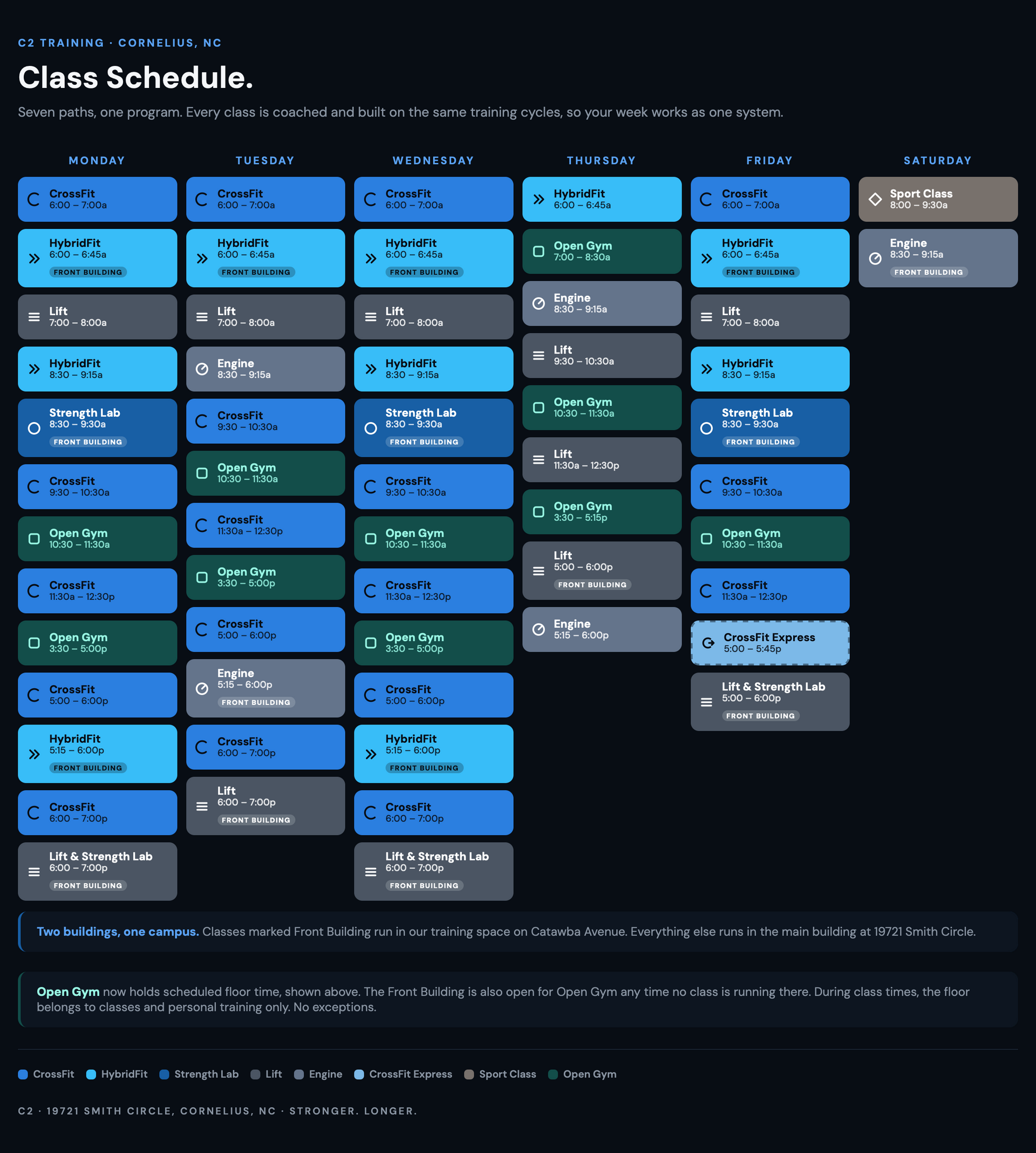
Here is where the new schedule comes in, and why it is a clarification rather than a pivot.
For over thirteen years, everything we believed had to fit inside one hour. Strength, conditioning, skill work, community, all of it compressed into the same window for every person who walked in, regardless of what that person actually needed that day.
That works, and it worked well for a long time. But it forces compromises. The member who needs to prioritize strength for the next six months gets fifteen minutes of it inside a class built for everyone. The member whose engine is the limiting factor gets a conditioning piece designed around a barbell they did not need to touch that day.
So we stopped compressing.
Lift is what happens when strength gets the whole hour instead of the majority of one. Same philosophy, more room. Real progressions, coached every set, built to compound across cycles.
Engine is what happens when conditioning gets built rather than tested. There is a difference between doing hard workouts and developing an aerobic base, and most people have only ever experienced the first one.
CrossFit Group Class is still exactly what it has always been, still the foundation here, still the room most members live in.
HybridFit, Strength Lab, Sport Class, Express, all of it is the same set of beliefs pointed at different people and different seasons of life.
Nothing about our philosophy changed.
We just stopped forcing every person's needs through the same sixty minute door.
What I would tell you to do
If you are training here and you want the short version of thirteen years of my opinion, it is this.
Prioritize strength. Make it the thing you protect on your calendar, the thing that does not get skipped when the week gets loud. Two or three days of intentional loading, coached, progressed, tracked.
Then build your engine on purpose, not as an afterthought. Not just hard workouts. Actual aerobic development, which is quieter and less satisfying and matters enormously.
Then let everything else be the fun part. Sport Class if you are chasing something. Express when the week ran long. Group class because you like the room and the people in it.
That is a complete training life. It is what I have been trying to build inside one hour for thirteen years, and now it has room to breathe.
The last thing
I know some people looked at the new schedule and saw a gym trying to be something else.
I understand why. The name on the building is changing, the class list got longer, and change invites that reading.
But what actually happened is simpler and less dramatic. We stopped being a strength and conditioning gym that had to describe itself in someone else's language, and started being one out loud.
The work has not changed. The barbell has not moved. We just built more room around it, so more of you can get to it in the way that fits your life.
For whatever it is worth, the ledger says 356,000 visits, 52,000 strength records, and just under 14 million pounds lifted in this room.
None of it happened in a day.
The work is not loud.
It compounds.
Onward and Upward
Mike