You Can Train Hard and
Still Not Be Training Right.
Ask most people what conditioning is and you get the same answer. It is the part where you breathe hard. Go hard enough, often enough, and you get fitter.
That is half right, which is why it works for about a year and then quietly stops working.
We added a class called Engine, and the question we have taken most often since is a fair one. How is that different from the conditioning at the end of a CrossFit or HybridFit class? It is all "hard".
Here is the honest answer:
CrossFit & HybridFit conditioning tests your engine.
Engine builds it.
A CrossFit or HybridFit piece is mixed on purpose. Several movements, a clock, a score, and a design brief that says make this hard. What it hands you at the end is a number, and that number is useful. It tells you where you stand today against where you stood in March, under messy conditions that look a lot like life.
That is a test, and tests are worth writing. We write them every week and they build real fitness. Nobody here is going to tell you that working hard does not count.
And ours are not thrown together. Every conditioning piece in this building, CrossFit and HybridFit alike, is written for a reason, with a shape, a time domain and a set of movements chosen on purpose, routed around that day's strength work and around every other program running that week. There is an intent behind Tuesday that is different from the intent behind Friday, and your coach can tell you what it is.
What a mixed piece cannot do is guarantee which system it trains in you.
That is not a failure of the writing. It is what mixed work is. Several demands go in at once, and the one you are worst at takes the largest share of the effort. Two people do the same piece off the same whiteboard. The one with a weak engine gets a lung workout. The one with a strong engine and a poor grip gets a forearm workout. Both did the session as written. They did not do the same training.
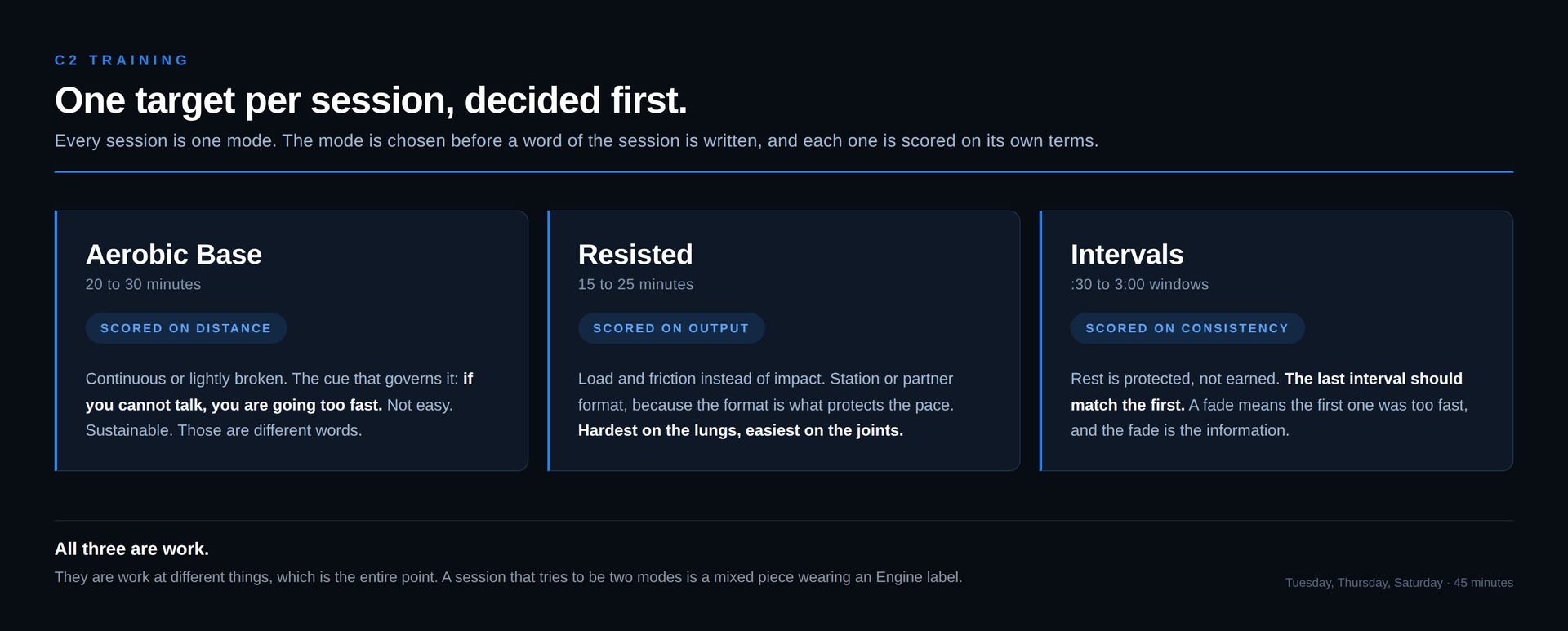
Engine narrows that on purpose. One system per session, chosen before a word of it is written, and a pace primer that puts every athlete on their own number inside that same system. What we aimed at and what lands in you are the same thing.
That is the difference, and it is not intensity, and it is not care. Both are hard. Both are written on purpose. Engine is the one where the aim survives contact with you.
Hard is not a plan. Hard is an ingredient. Every session in this building is hard at something, and the something is the decision.
It also explains the plateau better than effort does. Mixed work gives you a bit of everything, and a bit of everything is exactly right for a long time. But eventually the thing holding you back needs a bigger dose than a mixed piece can hand it without wrecking the rest of the session. That is where progress goes flat, and it is not because you stopped trying.
And there is a second reason a conditioning piece cannot do this job for you, one that has nothing to do with how hard you worked.
Conditioning inside a CrossFit or HybridFit class has another job. It has to route around whatever the day's strength work just did. It has to leave alone the machines the main lift needs, stay off the systems that were taxed twenty minutes ago, and fit into whatever the barbell left behind. It is excellent conditioning and it is doing all of that on purpose.
It is also, structurally, always a passenger. It is never the thing the session was built around, which means it never gets to pick its own stimulus either.
Engine is the one hour in the week where the aerobic system is the point rather than the leftover.
What actually happens Session to session
Three modes rotate, so no day of the week owns one. All three are work. They are work at different things, and each one is scored on its own terms.
What building it actually looks like over six week cycles
Every program in this building progresses exactly one variable, and no two programs progress the same one. That is not an accident. It is how seven formats stay out of each other's way.
Strength Lab progresses load. It is the only room where the number on the bar is the progression. CrossFit progresses tempo and time under tension. The lift gets slower rather than heavier. Lift progresses sets and volume. Same weight, same tempo, one more time through. Engine progresses pace. Specifically, duration and density at a pace you can hold, before the pace itself is allowed to climb.
So the question at the start of an Engine cycle is never how heavy. It is what number can you hold, how long can you hold it, and can you still hold it on the last one.
Across six weeks that looks like this:
Weeks one and two, calibrate.
You establish your number in all three modes and we write it down. Most of the room has never held a real aerobic pace on purpose and has no idea what their repeatable interval number actually is. Volume stays moderate here specifically so the pace is learnable.
Weeks three and four, volume.
Same pace, more of it. Base pieces get longer, rotations get denser, the interval count climbs while the window stays where it was. This is the stretch where the adaptation actually gets bought, and it is also the stretch where people want to go faster instead of longer. We will hold you to the number.
Week five, sharpen.
Windows shorten and the top end opens. The base you spent four weeks building gets expressed as speed.
Week six, test.
We retest the numbers from weeks one and two, side by side. Not a feeling. The same piece, the same number, six weeks apart.
If that structure looks familiar, it should.
It is a strength cycle.
Same shape, same logic, same six weeks.
The only difference is which variable is climbing.
That is what building an engine looks like. It looks like training, because it is.
The pace primer, which is the actual innovation
Every Engine session opens with one, and it is the piece that makes conditioning coachable at all.
Before the working clock starts, you find the number you are going to hold. Not a guess. A number, established at effort, with a coach watching.
Then you go hold it.
Compare that to how conditioning normally goes. You start, you feel good for ninety seconds because everyone feels good for ninety seconds, and then you spend the rest of the piece finding out you were wrong. You learn your pace by blowing up. Every single time.
Doing that once a week for a year is not pacing practice. It is a year of the same mistake with different movements.
If you came up through CrossFit, read this part twice
You have been trained to measure a session by the wreckage. A controlled twenty five minutes does not leave the same debris as a "good conditioning piece", so the instinct is to file it as less.
So here is the mechanism, because you will not take it on faith and you should not have to.
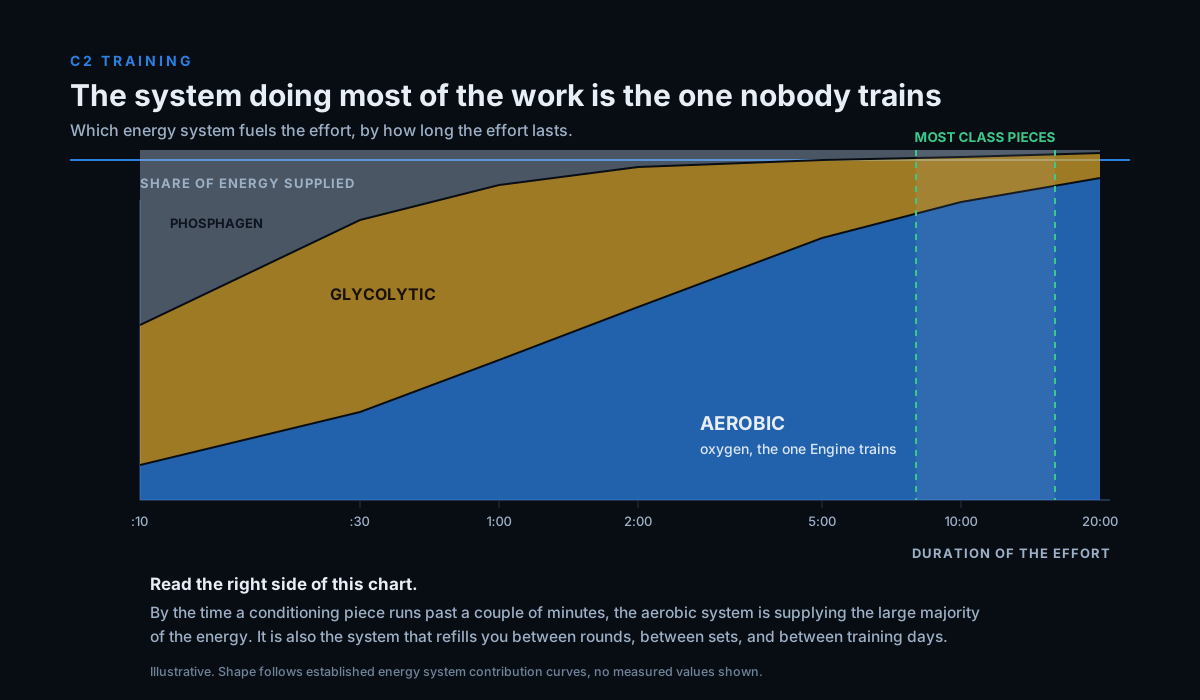
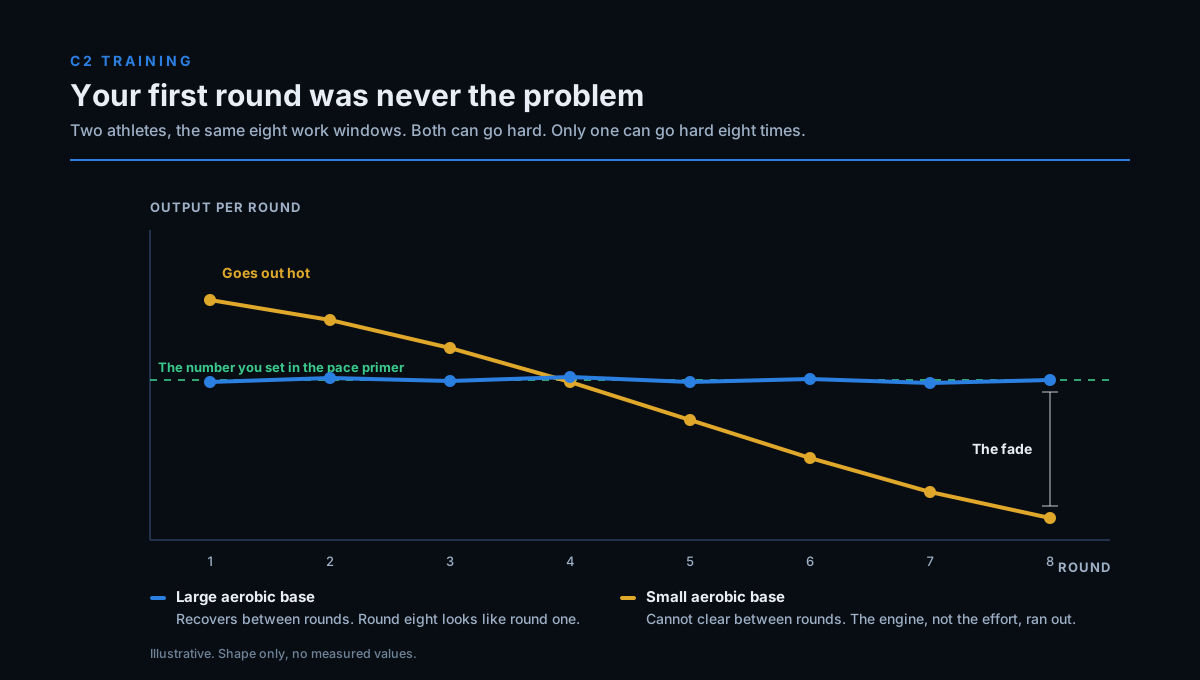
The thing that ends your conditioning piece is not your ability to go hard. You can go hard. You do it four times a week and you are good at it. What ends your ability to reach full intended stimulus of the piece is your ability to recover while you are still going, in the eight seconds between sets, in the walk back to the bar, in round four when your breathing does not come back down the way it did in round two.
That recovery is aerobic. And aerobic capacity gets trained across a wide range of efforts, base work included, which is the part of the range almost nobody here has ever deliberately trained outside of programmed attempts in conditioning.
Your first 500 meters was never the problem. Your fourth one was.
IT IS HUMBLING IN A WAY A MAX EFFORT NEVER IS, BECAUSE THERE IS NOWHERE TO HIDE.
A MAX EFFORT LETS YOU THROW EVERYTHING AT ONE REP.
CONSISTENCY ASKS WHETHER YOU ACTUALLY KNOW WHAT YOU ARE CAPABLE OF.
MOST PEOPLE FIND OUT THEY HAVE BEEN GUESSING.
Why it does not cost you your week
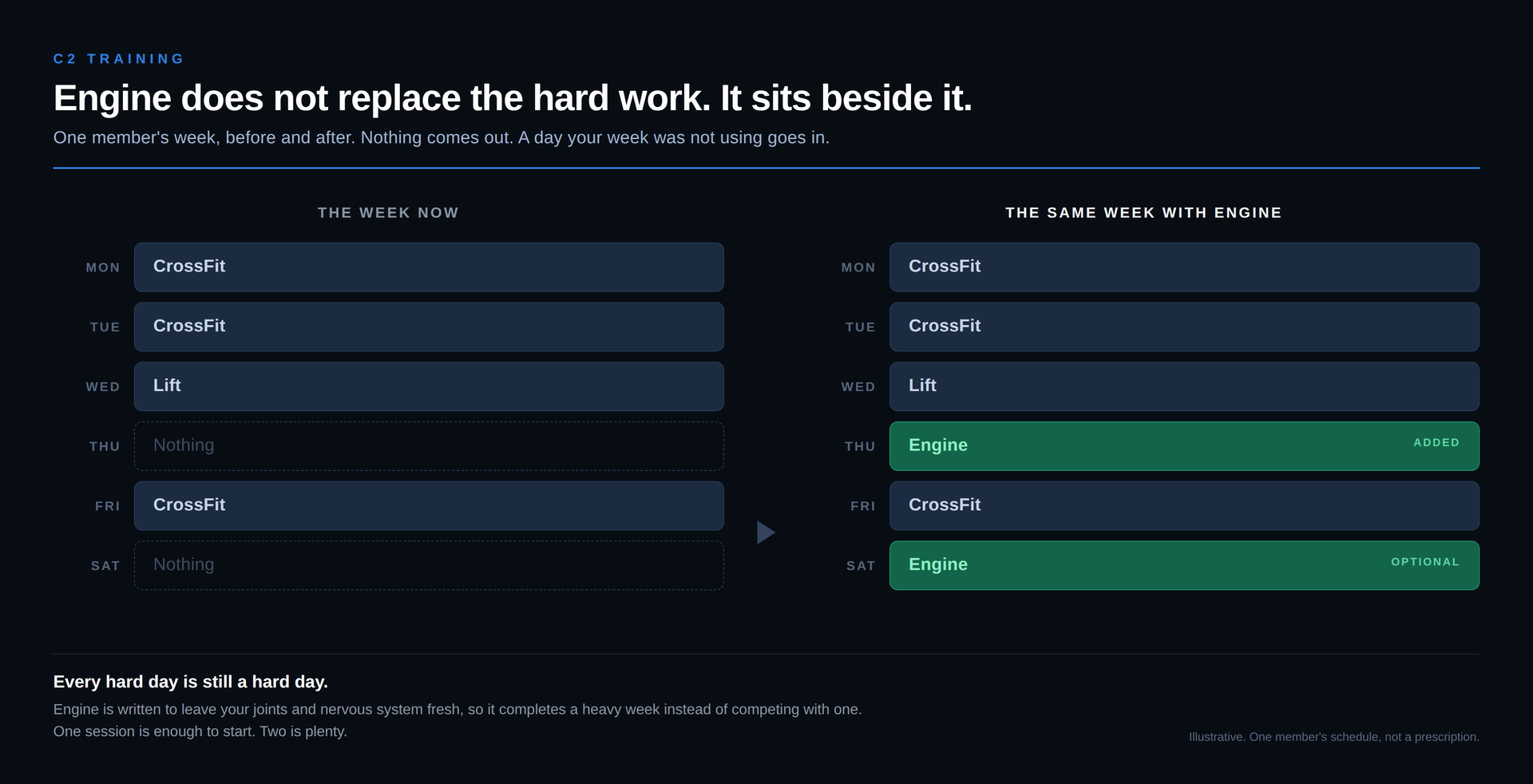
Engine is written to leave your joints and your nervous system fresh.
That is a deliberate constraint, not a side effect, and it is what makes the class stackable. A hard metcon spends things you need for your lifting days. One or two Engine sessions can sit beside a heavy Lift or CrossFit week and complete it instead of competing with it.
There is a test every Engine session has to pass before it gets written. If the piece would show up in your legs on a Lift Friday, it is too heavy, too impactful, or too long, and it gets rewritten. Load and friction instead of impact. Pace instead of weight.
Engine is not a barbell free zone. Barbells, dumbbells, sleds, machines, all of it shows up depending on the session.
You are not going to miss a rep in an Engine session because the weight was too heavy or the movement was too technical. That is designed out. If you have to slow down, your lungs slowed you down, and your lungs are the only thing the session was ever testing.
The standard we hold ourselves to is simple. If you run CrossFit, Lift, and Engine in the same week, you should feel Engine in your lungs on Wednesday morning and nowhere else.
The reason any of this matters outside the gym
Aerobic capacity (along with strength) is one of the strongest predictors of healthy lifespan we have. It is also the quality that declines first and fastest when nobody trains it.
That is not about a workout score. It is about long days, travel, hills, stairs, carrying things, keeping up with people fifteen years younger than you, and the difference at seventy between managing your life and needing help with it.
Strength gets all the attention, and we spend more hours on it than anything else in the building. But strength is only half the equation.
Lift builds the machine. Engine builds the motor.
WHO IT IS ACTUALLY FOR
The member whose strength is solid but who gasses out in anything long.
The runner, cyclist, or weekend athlete who wants structured conditioning without adding more barbell volume to the week.
The member easing back in after time away, who needs a base before loading up, and who would rather not find their limit by accident in a conditioning piece.
And anyone training for the long game, who has worked out that the heart is a muscle too.
Which is most of you. All levels, every piece scales, and nothing in the room is loaded heavy enough or technical enough to beat you.
Tuesday, Thursday, Saturday. Forty five minutes. Included in your membership, same as any other class on the schedule.
Come learn your numbers.
Get Your Performance Assessment
Learn More About Our Programs