Before It Hurts
The Best Time to See a Physical Therapist Is When Nothing Hurts
There is a version of physical therapy that most people have in their heads, and it goes like this. Something tears, breaks, or seizes up. A doctor writes a referral. You spend six weeks in a beige room doing exercises with a resistance band while a clock runs somewhere, and then an insurance company decides you are finished. You leave roughly functional and having learned almost nothing about why it happened in the first place.
That version exists. It is also the smallest and least interesting part of the profession.
The larger part, the part that changes how long you get to keep doing the things you like doing, happens well before any of that. And it is almost entirely unused, because the category is misnamed in the public imagination. People hear physical therapy and think injury. So they wait.
Nothing takes you out without warning
This is the part worth sitting with.
Injuries feel sudden to the person they happen to. They rarely are. The back that goes on a Tuesday afternoon was being loaded poorly for a year. The shoulder that finally gives out spent two seasons compensating for a range of motion it quietly lost. The knee that starts complaining at 47 is reporting on a movement pattern that was established at 30.
Bodies are extraordinarily good at working around a problem. That is a feature, and it is also the trap. The compensation is invisible to you because it feels normal, and it feels normal because it has been happening for years. Eventually the compensation itself becomes the injury.
Which means there is almost always a runway. A long window where the problem is visible to a trained eye, cheap to address, and completely painless. Almost nobody uses it.
What a physical therapist does when nothing is wrong
A doctor of physical therapy is trained to look at human movement and identify dysfunction. Pain is one input. It is not the only one, and it is usually a late one.
Put in front of someone who feels fine, a good practitioner is asking a different set of questions. Where is this person losing range and covering for it somewhere else? Which side is doing more work than it should? What happens to this pattern when the load goes up or the person gets tired? What in this body is going to fail first if nothing changes, and what would it take to change it?
None of that requires an injury. All of it requires someone who knows what they are looking at watching you move.
The output is not a diagnosis and a six week protocol. It is usually a short, specific list. Two or three things, often unglamorous, that if addressed now prevent a much larger conversation later.
The other work people do not know about
Beyond assessment, the scope is wider than most people expect.
Dry needling. A thin filament needle into a dysfunctional muscle to release tension and restore normal function. Frequently used on tissue that is not injured at all, just chronically tight and limiting.
Manual and soft tissue work. Hands on treatment to restore mobility. This has real overlap with what people book massage for, with a clinical assessment attached to it.
Pelvic floor physical therapy. One of the most under discussed areas in the profession and one of the most consequential, particularly for women in their late thirties through their fifties. The symptoms that get treated as an unavoidable consequence of childbirth or age are, in a large share of cases, treatable. Most people never find out because nobody told them the category existed.
Return to capacity after surgery or pregnancy. Being medically cleared and being ready to perform are different things separated by a gap that most people cross alone and by guesswork.
Performance work. Athletes at high levels have used physical therapists preventatively for decades. Not because they are fragile, because the cost of losing a season is high enough to justify being deliberate. The logic holds for anyone whose training matters to them.
Why on site changes the outcome
There is a structural problem with how rehab normally works, and it has nothing to do with the quality of the practitioner.
You get treated in one building by someone who never speaks to the person writing your training in another building. So one of two things happens. Either you stop training entirely and lose months of accumulated work, or you keep training with no adjustment and undo the treatment every time you come in.
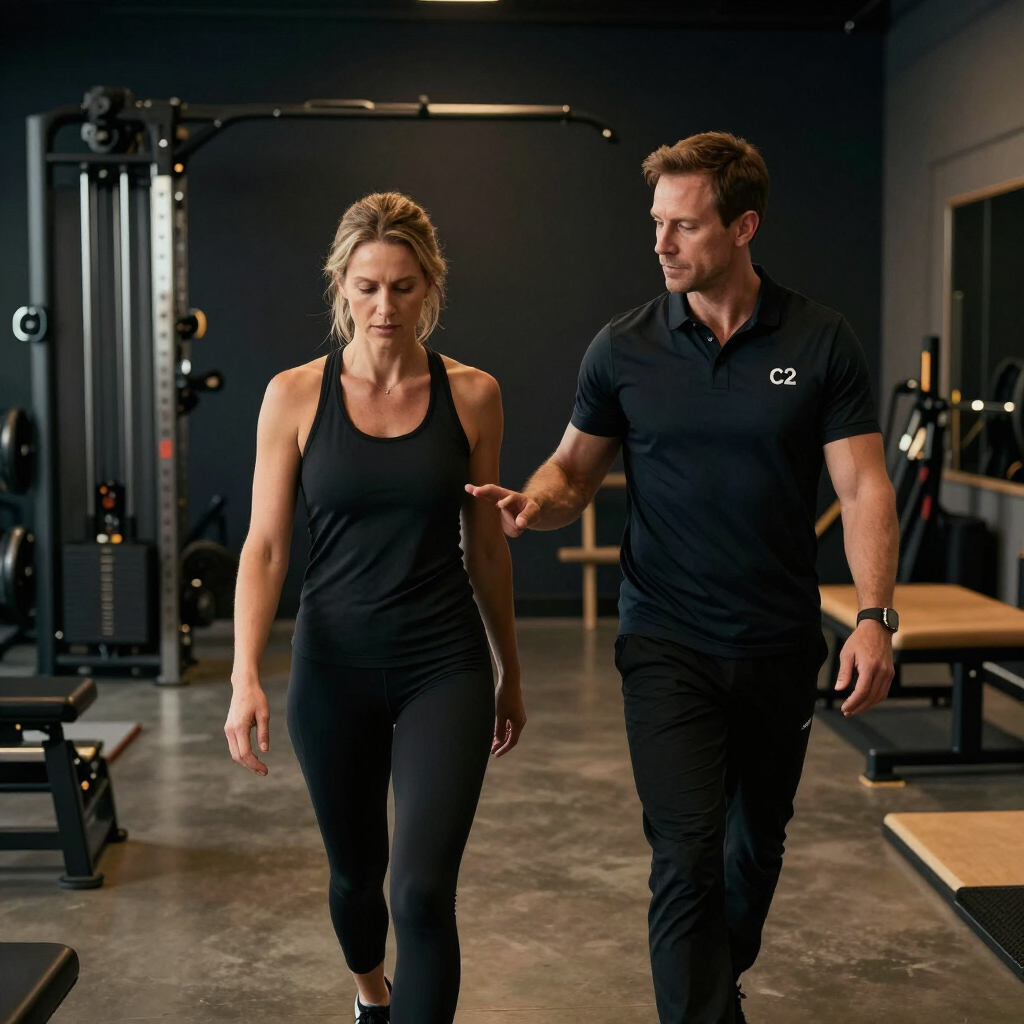
At C2, Return 2 Play operates inside the facility. Dr. Lauren Gass talks to the coaches directly about the members they share. When something is found, the training is modified around it that week. The member does not pause, does not lose progress, and does not have to translate clinical instructions to a coach who never got the context.
That is not a convenience feature. It is the difference between a plan that works and two plans that fight each other.
Who this is actually for
If you are hurt, see a physical therapist. That has never been in question.
The argument here is about everyone else. If you have a thing you have been training around for months and stopped mentioning. If you are past forty and would like a specific answer about what is going to limit you at sixty.
If you sit for nine hours and then ask your body to perform for one. If you were cleared after a surgery or a pregnancy and never assessed under load. If you feel completely fine and would like to know where the weak links are while they are still cheap to fix.
You do not need to be injured. In North Carolina, you do not need a physician referral to be evaluated by a physical therapist.
Where to start
The entry point is an Initial Evaluation. About an hour, a structured assessment of how you actually move, and a clear read on what is worth addressing. Some people leave with two things to work on and never need another appointment. Some find something worth treating. Both are useful outcomes, and either beats finding out the hard way in two years.
Return 2 Play Physical Therapy is led by Dr. Lauren Gass, DPT, and operates on site at C2 Training in Cornelius, North Carolina.
Book directly at link below, or if you train at C2 and are not sure whether your particular thing is worth bringing to her, ask your coach.
That conversation takes two minutes and costs nothing.